



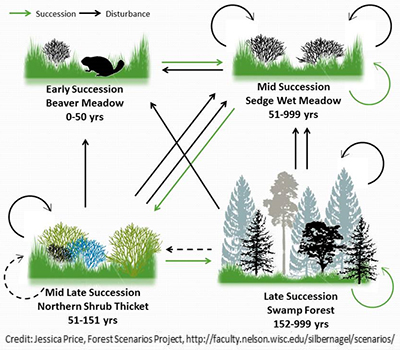
 LANDFIRE (LF) calls historic (pre-European settlement) ecosystems "Biophysical Settings," or BpS. To better understand how BpS functioned across the United States, LF worked with hundreds of experts to develop descriptions and models. The results are combined into "sets" or bundles that are available to anyone for free online.
The What and the How of BpS Models
LF used an expert-based development process to create state-and-transition models that describe pre-settlement ecosystem structure and function for every Ecological System present in the current LF BpS spatial dataset. Each ecosystem, which LF calls a Biophysical Setting (BpS), has a description document and a quantitative state-and-transition model including succession/growth and disturbance that can be viewed and manipulated in the free modeling platform SyncroSim.
LF used the BpS models to estimate reference conditions (sometimes referred to as "Natural Range of Variability" or NRV) for each BpS, which are then used to help evaluate ecosystem health through a departure metric called Vegetation Departure. The document "Using the LF Biophysical Settings Model Descriptions" examines major elements of the BpS descriptions and their uses. In addition, expert-developed models and descriptions are the source of LF's historic fire regime information.
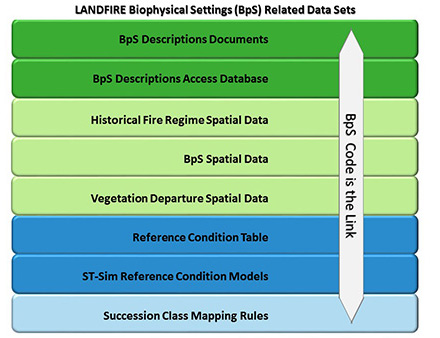 COLLABORATION BETWEEN LF + EXPERTS = MODELS
In 2015, LF began a multi-year project to review and improve the BpS data. The updated BpS model and description suite is now available for download below.
Vegetation dynamics models: a comprehensive set for natural resource assessment and planning in the United States
This article describes the ongoing development of a comprehensive set of vegetation reference conditions based on over 900 quantitative vegetation dynamic models and accompanying description documents for terrestrial ecosystems in the USA.
Supporting Information
Online resources for modelers include ApexRMS (ST-Sim developers), ST-Sim download, Forum and SyncroSim (ST-Sim) Online Documentation
How others use BpS Models
A variety of applications of BpS models have been described in project reports, meeting presentations, posters and journal articles. Examples include:
- Linking state-and-transition simulation and timber supply models for forest biomass production scenarios by Costanza, Abt, McKerrow, and Collazo
- Enhanced conservation action planning: Assessing landscape condition and predicting benefits of conservation strategies by Low, Provencher, and Abele
Download BpS Models and Descriptions
- Compiled databases in the Lower 48 States and Hawaii OR Alaska extents using links in the table
BpS model information
Biophysical Settings Models, Descriptions and Related Information
- State-and-Transition Models: quantitative models of pre-European settlement ecosystem dynamics
- BpS Descriptions: Full textual descriptions of each BpS, including model parameters and succession class rules
- Reference Conditions: estimates of the percent of each succession class on the landscape prior to European settlement for each Ecological System
- Succession Class Rules: Combinations of vegetation type, vegetation cover, vegetation height, leaf-form and life-form that are used by LF to map the current extent of succession classes
- Metadata: FGDC compliant metadata for the BpS models and descriptions
- Spatial data - learn more
Unsure of which model you need? Use the searchable BpS website to locate and download specific BpS models and descriptions.