


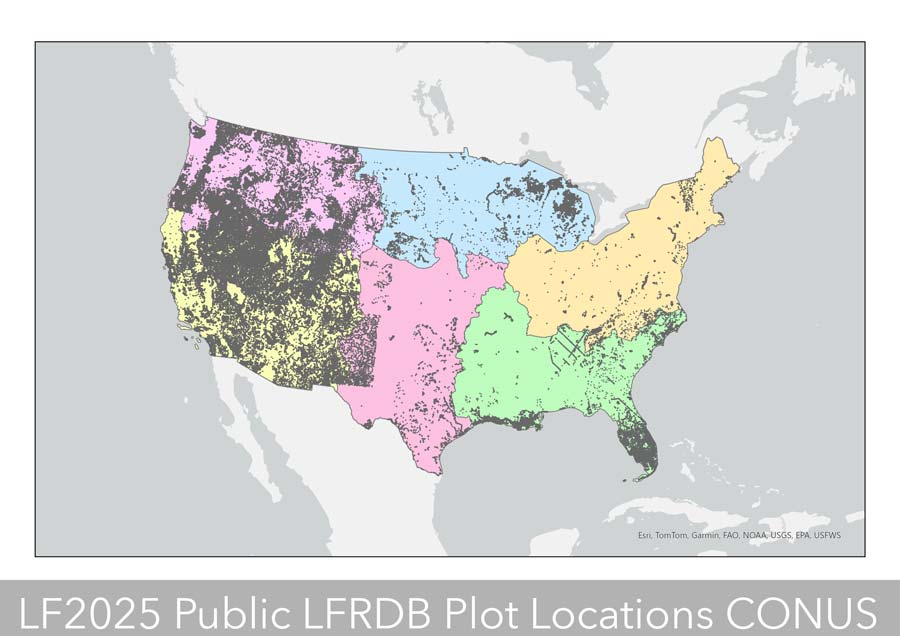
The LANDFIRE Reference Database (LFRDB) is a collection of field-sampled vegetation and fuel data used to develop and validate LANDFIRE products. It contains over 1 million georeferenced plots collected across the United States from federal, state, academic, and other partner organizations.
The plots approved for public release comprise the Public LFRDB, a subset of the vegetation and fuel plot data used in LANDFIRE production. To support public access and comply with data-sharing agreements, proprietary and sensitive information has been removed from the publicly available database.
The database includes information such as:
| Vegetation |
|
| Fuel |
|
In addition to field measurements, the database includes derived attributes such as:
- Ecological System Classifications
- National Vegetation Classification System (NVCS) group labels
Tree, shrub and herb cover and height estimates
Improvements Featured in the LF 2025 Update
More than 74,000 plots were added to the database for the release of LF 2025, significantly expanding the available field reference data. These additions came from several major partner programs, including:
- Bureau of Land Management (BLM) Assessment, Inventory, and Monitoring (AIM)
- National Ecological Observatory Network (NEON)
- National Park Service Inventory and Monitoring (I&M)
This new data improves the geographic coverage and representation of vegetation and fuel conditions available through the Public LFRDB.
How Can the LFRDB Be Used?
The Public LFRDB is a valuable resource for researchers, land managers, and modelers who need field-based vegetation and fuel information.
Common applications include:
- Supporting spatial and non-spatial vegetation modeling
- Ground-truthing vegetation and fuel maps
- Evaluating mapping and classification accuracy
- Ecological and landscape analyses
- Fuel characterization and fire management planning
- Research and educational projects
Information about data sources included in the database can be found in the lutdtVisitsSourceID table.